-260719-4-edited.png)
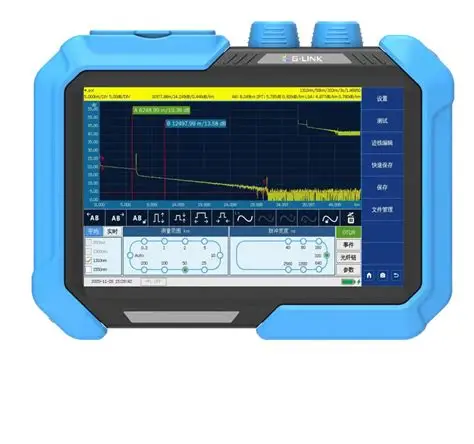
Behind every reliable OTDR lies a power system that must support continuous, accurate testing in a variety of field conditions. As OTDR devices become more portable, field-deployed, and capable of long-duration operations, the performance of their battery systems is critical to their success.
Tefoo Energy provides customized 18650 lithium-ion battery packs, designed specifically for OTDR applications. Our batteries are optimized for performance, longevity, and reliability, ensuring your OTDR systems stay operational when it matters most.
OTDR Systems Demand Power Reliability and Accuracy
OTDR devices operate in diverse and often challenging environments, from underground fiber installations to outdoor testing across large distances. The core functionality of an OTDR includes signal injection, reflection measurement, data analysis, and distance-to-fault calculation. These operations require a consistent and stable power source to maintain accuracy, especially when working with long fibers or low reflection signals.
For OTDR systems, power instability can introduce errors in measurement, reduce testing accuracy, or cause shutdowns that result in lost testing time. As the OTDR device’s performance is directly related to the quality of its power supply, Tefoo Energy’s battery solutions are specifically designed to meet the high standards required for these demanding tasks.
Why 18650 Cells Are Ideal for OTDR Systems
OTDR systems demand high energy density, mechanical robustness, and predictable electrical behavior. The 18650 lithium-ion cell format is a perfect fit for these needs due to its established history in portable, high-performance applications.
Tefoo Energy uses Panasonic 18650 cells, renowned for their high energy density, excellent charge/discharge stability, and long cycle life. These attributes ensure that OTDR devices maintain consistent performance even during prolonged testing periods or across multiple operational cycles.
The maturity of the 18650 format also provides assurance of long-term supply continuity and minimal risk of component obsolescence, which is crucial for maintaining the operational reliability of OTDR systems over time.
Powering Real-Time Measurements and Accurate Distance-to-Fault Detection
OTDR systems perform real-time measurements of fiber quality, reflecting light pulses back from fiber junctions and faults to determine the exact location of issues. This process is extremely sensitive to fluctuations in power supply. Any instability or interruption in the battery’s voltage could distort the measurement results, leading to incorrect distance-to-fault calculations or poor signal quality.
Tefoo Energy’s customized battery packs provide consistent voltage and low impedance, supporting real-time measurements without fluctuations or distortions. This ensures that OTDR systems deliver accurate distance measurements and clear fault identification, even during extended testing periods.
📊 Table 1: OTDR Functions vs Power System Requirements
| OTDR Function | Power Requirement | Impact of Unstable Power |
| Signal injection | High current, stable voltage | Power dips can result in weak pulses, affecting measurement accuracy |
| Reflection measurement | Stable, continuous power | Inaccurate reflections or data loss |
| Distance-to-fault calculation | Consistent voltage for precise calculations | Incorrect fault location or false readings |
| Data analysis | Low to moderate power during processing | System shutdown or data loss |
Continuous Operation with Long-Duration Testing
OTDR devices are often used for long-duration testing, especially in large-scale fiber optic installations or during network verification. In these applications, the battery system must support continuous operation for several hours to ensure that the technician can complete the test without interruptions.
Tefoo Energy’s 18650 lithium-ion battery packs are designed for long-lasting performance, allowing OTDR devices to remain operational during extended tests. Additionally, the high-density cells ensure that the device can handle prolonged usage without sacrificing performance or battery life.
📊 Table 2: Long-Duration Operation vs. Battery Capacity
| Battery Capacity | Duration of Testing (Approx.) | Application Use Case |
| 2000mAh | 4–6 hours | Standard OTDR testing (short-distance fiber) |
| 3000mAh | 6–9 hours | Long-distance fiber testing and real-time monitoring |
| 5000mAh | 10+ hours | Extended testing sessions for large-scale network installations |
Intelligent Battery Management for Field Use
OTDR systems are typically deployed in remote or rugged environments, where access to charging equipment may be limited. In these scenarios, the battery must provide the power necessary to complete testing while also communicating its status to the device in real time.
Tefoo Energy integrates SMBus v1.1 communication into each battery pack, enabling the OTDR to monitor key metrics such as state of charge (SOC), temperature, and health. This allows technicians to track battery performance, avoid unexpected shutdowns, and better manage battery replacements.
An integrated fuel gauge ensures accurate runtime predictions, allowing users to plan and schedule battery swaps or recharges efficiently during field operations.
📊 Table 3: Battery Communication and Monitoring in OTDR Systems
| Feature | Why It Matters | Tefoo Energy Implementation |
| State of Charge (SOC) | Prevents unplanned power loss during field testing | SMBus communication & real-time monitoring |
| Temperature monitoring | Ensures safe operation and prevents overheating | Integrated thermal sensors for accurate control |
| Health monitoring | Prolongs battery life and optimizes use | Smart battery management with fuel gauge and protection |
| Runtime prediction | Allows for efficient field planning | High-precision fuel gauge with adaptive algorithms |
Designed for Field Service and Modular Power Solutions
OTDR devices are frequently serviced in the field or undergo periodic battery replacements. Tefoo Energy’s battery packs are designed for easy servicing and replacement, allowing for rapid battery swaps without requiring special tools or equipment.
The modular design ensures that new battery packs are compatible across a range of OTDR models, simplifying maintenance and reducing the cost of stocking multiple parts.
📊 Table 4: Battery Replacement Flexibility for OTDR Devices
| Design Feature | Benefit for Field Technicians | Tefoo Energy Solution |
| Modular battery design | Simplifies replacements and repairs in the field | Interchangeable packs across OTDR devices |
| Quick swap functionality | Reduces downtime and increases operational efficiency | Easy-to-disassemble, pluggable battery modules |
| Extended battery life | Less frequent replacements and servicing | Panasonic 18650 cells with long cycle life |
Application Scenarios for OTDR Battery Systems
Tefoo Energy’s customized 18650 battery packs are suited for a wide variety of OTDR applications, including:
- Fiber optic network installation: Long-duration testing in remote locations.
- Field troubleshooting: Quick, reliable performance during fault location.
- Continuous network monitoring: Long-term monitoring of fiber networks in real-time.
In all of these use cases, our batteries provide the consistent, reliable power that ensures accurate measurements and uninterrupted testing.
Why OTDR Manufacturers Choose Tefoo Energy
Tefoo Energy is committed to delivering customized battery solutions that meet the demanding requirements of modern OTDR systems. By combining certified safety, Panasonic cell quality, intelligent communication, and modular flexibility, we provide a reliable power source for the precision testing that OTDR devices are designed to perform.
With Tefoo Energy, OTDR manufacturers can ensure that their devices provide uninterrupted power, consistent accuracy, and long-term operational reliability.
FAQ – OTDR Battery Solutions
Q1: Why is a customized battery important for OTDR devices?
Because OTDR systems require stable and precise power delivery to ensure measurement accuracy and fault location precision.
Q2: How does Tefoo Energy ensure long-term battery reliability for OTDR?
We use Panasonic 18650 cells with high energy density and exceptional stability, designed to perform under prolonged usage.
Q3: Can Tefoo Energy’s batteries support extended testing sessions?
Yes. We offer battery capacities that support testing from 4 hours to 10+ hours, ensuring continuous operation.
Q4: Is battery replacement easy in the field?
Yes. Our modular design and quick-swap functionality make it easy for technicians to replace batteries on-site without downtime.
Q5: Are Tefoo Energy batteries suitable for both indoor and outdoor OTDR testing?
Yes. Our batteries are designed to perform consistently in both controlled environments and challenging outdoor conditions.